





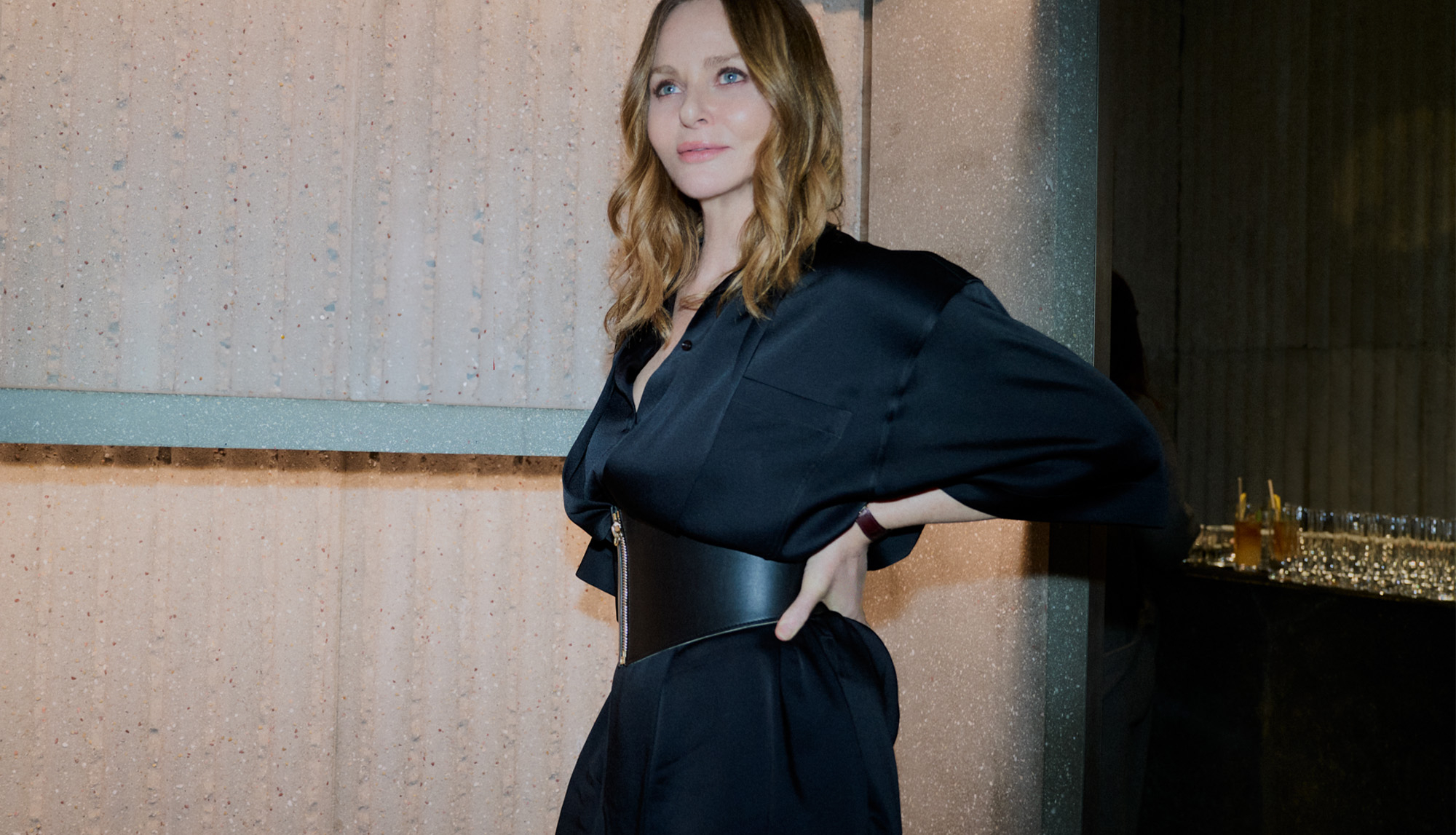
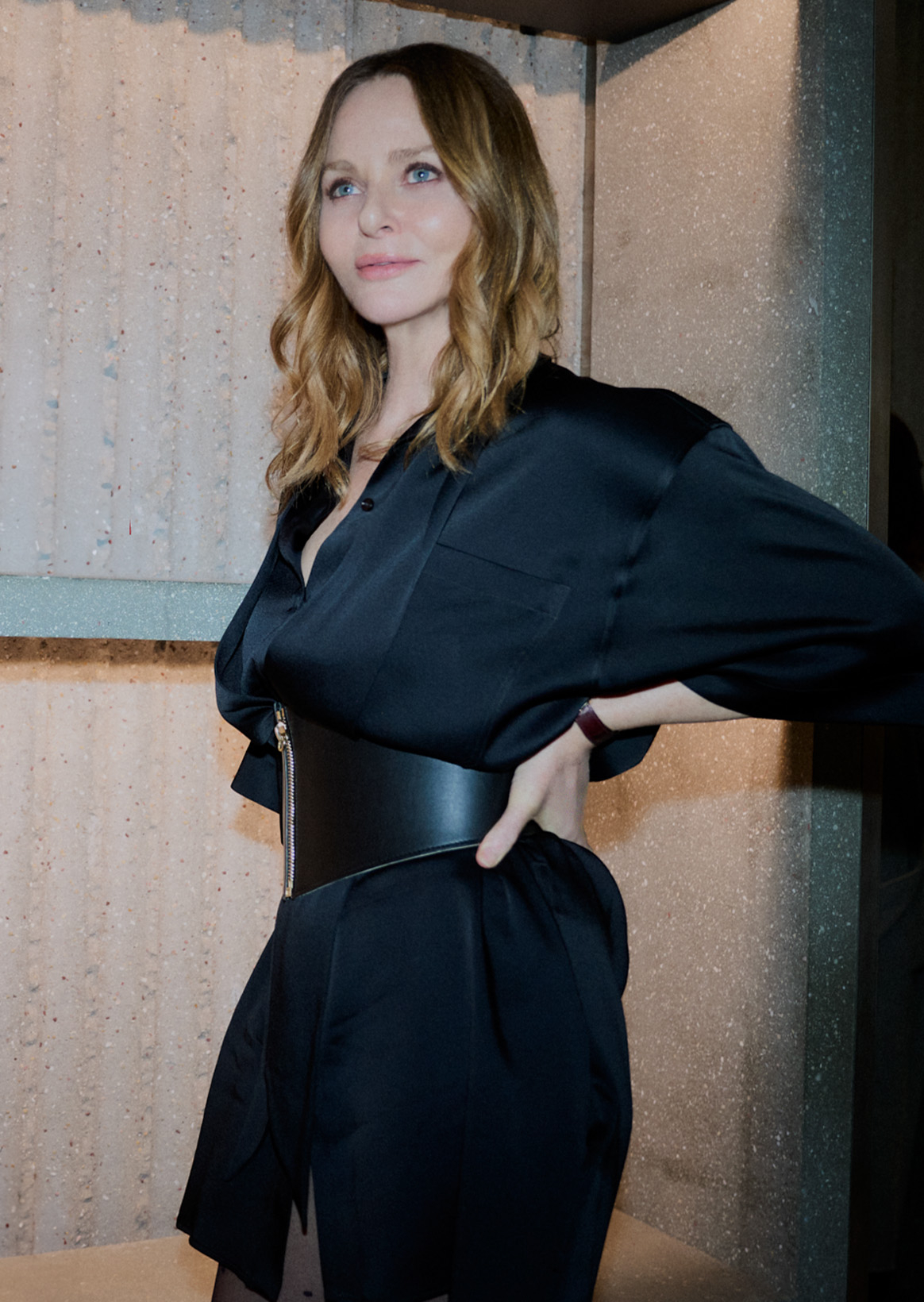
2001年在英国伦敦成立了自己的奢华时装屋“Stella McCartney”的Stella McCartney。从当时开始就把可持续性和时尚两立作为品牌理念,在巴黎时装周举行的2025年夏日巡演中,从作家兼野鸟观察家乔纳森弗朗森的著作《The End of the Earth》中获得灵感,96%使用环保材料,展开了不伤害生物的收藏。4月18日(周五),在涩谷PARCO开设了新的“Stella McCartney”店铺。<阿迪达斯>为庆祝RASANT的日本限定颜色(BLACK)推出,向来日本的她询问了她培养独一无二的创意环境以及对自己品牌的想法。
※ The English version is available below.
- Photo
- Sachiko Saito
- Text
- Tomoko Ogawa
- Edit
- RIDE Inc.
——从幼年时期开始形成自我最有影响的事情是什么?
创建一个可持续发展品牌的决定很简单。那是我成长的环境,是从小就被教导的。4岁或5岁的时候最美好的回忆是,我的母亲和父亲发现自己有一个衣柜。有绝对的安德罗西尼(具有男女两性的特征)。那是Wings活跃的格洛克时代。我以为是母亲的衣服的一半,父亲也实际穿了。从那以后,我从母亲的档案中发现了花纹的衬衫,“这件衬衫太帅了!”这么想的时候,有父亲穿着那个的照片。明明是几年前的事了,却非常现代,那现在也是最先进的话题。像这样从小就被衣服包围着,对我自己和现在的工作方法产生了很大的影响。
——有没有留在心里的音乐?
我总是回到与父母的音乐,尤其是Wings一起巡演时的音乐。那是我的童年。您可以在苏格兰的荒野上骑马,或者在前往下一个吉格的途中搭乘巴士。这是我人生中一个非常令人兴奋和情感丰富的时期。他们的音乐被刻在我作为一名设计师和一个人的DNA中。
——请告诉我您自己的独创性和创造力的环境。
我认为时装设计和建筑之间有一个有趣的相似之处,但当我在中央马丁时,我意识到自己没有学习时装设计的技术方面。比起学习技术方面的知识,比如削减我想做的泰拉德夹克图案,更注重创造力。于是就进了萨维尔罗。我记得我和时尚界的“建筑师”一样的人一起工作。这是支撑着基础的存在。制作夹克就像建造建筑物一样,非常有趣,在那里修行了3年,基本上学会了在蒸汽上的癖好。在这三年里我学到的技术,至今仍在我的基础上,我认为泰拉林将永远是“史黛拉麦卡特尼”DNA的一部分。
——对你来说,成为游戏规则改变者的重要时刻和事件是什么?
中央圣马丁队的毕业表演相当重要。凯特摩斯、尚美坎贝尔和雅斯明尔本作为模特在那里,穿着我的衣服至今仍然清晰地记得,这是令人难以置信的光景。
——持续兼顾时尚与可持续发展的品牌“Stella McCartney”最重视的是什么?
我们的价值观始终植根于优雅的斯蒂拉妇女,他们不害怕发出大胆、强大和深刻的信息。我想让女性们感受到自信和力量,所以西服要注意独特的轻松和易用性。我们还意识到自己是一家道德和现代化的公司,并始终考虑所使用的资源和对环境的影响。“Stella McCartney”这个品牌正在创新新的方式,从设计到店铺实践,再到产品制造,让我们更加可持续发展。
——品牌、企业也反映了你自己的生活方式。
我一生都是素食主义者,我在收藏中没有使用任何皮革、羽毛、毛皮和异国情调的皮肤。不仅如此,还与下一代的创新者合作,为生物和母亲地球创造了友好的替代方案。我联合成立的投资基金SOS基金支持那些有着可持续发展愿景的人,并帮助市场推出新材料,如KelsunTM Seaweed Yarn(来自海藻的纤维和线状的生物基材)和Protein Evolution(使用人工智能和酶从塑料废物中回收的无限可回收聚酯)。为了有言实行,在斯蒂拉每天都在实际实践。
——基于把动物爱护和环境保护放在第一位考虑的生产背景,对于穿着的人们和对社会之后的影响,你有什么样的想法?
从一开始,珍惜动物就推动了我在私生活中的选择,并推动了我对Stella McCartney这个品牌的愿景。17年前,我读了联合国《Livestock's Long Shadow》(Livestock's Long Shadow),把这种精神与畜牧业对环境的影响联系在一起时,一切都令人佩服。
时尚是地球上最有害的行业之一。畜牧业约占全球温室气体排放量的14.5%,超过运输业的13%。这就是皮革的起源。皮革不仅促进了饲养牛的土地建设对热带雨林的破坏,还将约300kg的有毒化学物质排放到环境中,流入地域的水系。此外,皮革必须用致癌化学物质舔,通常在最贫困的国家大大缩短了工厂工人的寿命。这在各个层面都是残酷的。
每年饲养和屠杀超过10亿只动物,为时尚行业提供皮革。因此,我认为公众、企业和政府应该关注的最重要的事情是畜牧业及其对我们的环境和工业的影响。企业应摆脱这些伤害工人和动物的传统有害材料和方法。我们还需要超越行业传统处理的有限材料,在替代方案中具有创造性和创新性。如果朝着这些目标努力的话,不仅可以从地球上夺走,还可以用再生的方法实际开始商业吧。
——作为消费者,我们能做些什么吗?
大家也在向品牌和政府寻求透明度和说明责任方面,承担着应该发挥的重要作用。另一方面,政府需要为企业以更可持续的方式开展工作创造激励措施。例如,在美国,我的品牌在进口用维根材料代替皮革制成的产品时,要缴纳高达30%的税款。这是皮革行业游说的直接结果,与我们应对气候变化和保护地球为子孙后代的共同目标背道而驰。
——现在有特别致力的材料开发和项目吗?
新的2025年夏令营以96%的环保材料制成,这是迄今为止最可持续的收藏品,我们感到非常自豪。兰威秀是以作家兼野鸟观察家乔纳森弗朗森的著作《The End of the End of the Earth》为灵感,称赞鸟们,呼吁行动的收藏品。鉴于每年有超过34亿只鸟被伤害或杀害,2025年夏季收藏不使用皮革、羽毛、毛皮和异国情调皮肤,而是使用克鲁尔提夫利(※产品到达消费者手中之前的任何阶段都没有使用动物进行实验)的创新材料。
作为来自动物的皮革替代材料,世界上第一个使用Hydefy(以菌类为基础的纺织品)的手提包KelsunTM服装(以海藻为基础的纺织品),以及由PEEKABOO回收尼龙线编织而成的云状针织衫。此外,珠宝以鸽子为主题,由886 by The Royal Mint合作,由电子产品和医疗废物再生的金银制成。支持下一代创新者进入市场并扩大规模对我来说至关重要,本赛季能够处理这些令人惊叹的纺织品真的是一个愉快的机会!
——至今为止在活动中所接受的、难忘的话语是什么?
被称为“生态怪人”! 不使用动物性素材就能成功的时尚品牌是不可能的。尽管这么说,我还是做完了。我认为这是我们作为一个品牌迄今为止做过的最现代的事情。我们证明我们可以使不可能成为可能,在不伤害动物和地球的情况下,获得美丽和理想的奢侈品。虽然发生了一点点的变化,但是有必要让更多的人和我们一起走下去。还有很多事情要做!
——为了在人生中继续实现你想做的工作,你认为必要的是什么?
贯彻自己的信念,用自己的方式推进事物的话,即使说生意不会成功,也不要改变工作方式。我觉得在史黛拉麦卡特尼做的事情,以及我们从创业时开始做的事情,终于被认识到,变得认真接受了。那是非常荣幸的事。这种情况鼓励和讨论在时尚行业开展业务的其他方式,以挑战现状并对地球产生积极影响。
——请告诉我您对日本的印象和来日本时的回忆。
我自古以来就很喜欢日本的文化、时尚、音乐和艺术。这次来日本的时候,心中留下的回忆之一是在东京的时候见到了好友奈良美智。他是一位非常棒的艺术家,我觉得我们有着相同的愿景和价值观。
Stella McCartney established her eponymous luxury fashion house, Stella McCartney, in London in 2001. Since then, she has championed the coexistence of sustainability and fashion as the core philosophy of her label. At the Summer 2025 runway show during Paris Fashion Week―drawing inspiration from author and birdwatcher Jonathan Franzen’s book The End of the End of the Earth―she presented a collection made with 96% environmentally conscious materials, produced without harming any living creatures. On Friday, April 18, a new Stella McCartney store will open in Shibuya PARCO. Visiting Japan to commemorate the launch of a Japan-exclusive color (BLACK) of RASANT, a collaboration with Adidas, she spoke about the environment that shaped her distinctive creativity, as well as her thoughts on the brand.
——What has had the greatest influence on shaping who you are since childhood?
The decision to create a sustainable brand was easy; it’s what I grew up with and what I was taught from a young age. Some of my biggest memories from when I was four or five year old involve sitting in my parents’ wardrobe, and what was fascinating was I realised my mum and dad shared it. There was this absolute androgyny. It was this period of glam rock, during Wings. Half the things I assumed were mum’s, dad was actually wearing as well. They would swap. I’ve since worn a flowery shirt out of the archive and thought, ‘Oh look at this blouse of my mum’s, it’s so cool!’ Then we’d find a photo of my dad wearing it. It’s so modern; this was years ago, but today it’s a cutting-edge conversation to have. So, this upbringing and being around clothes from a very young age was a huge influence on me and has heavily inspired how I work today.
——Are there any films, music, or books (including photography books) that have left a lasting impression on you?
I always go back to my parents’ music – especially their time when they were touring with Wings. That was my childhood: going from riding on horseback in the wilds of Scotland to being on a tour bus on the way to the next gig. It was an incredibly exciting and emotional time in my life. Their music is in my DNA as a designer and a person.
——Could you share the environments, experiences, or things that have nurtured your originality and creativity?
I like to think that there are interesting similarities between fashion design and architecture in that when I was at Central Saint Martins, I realised that I wasn't learning the technical side of fashion design. The focus was on being creative rather than learning the technicalities, such as cutting patterns for a tailored jacket, for example, which is what I wanted to do, so I went into Savile Row. I remember working with those guys who I thought were like the builders of the fashion industry – you know, the nuts and bolts. Making a jacket is really like building a building, and it was just fascinating to me. I did that for three years, and I just about learned how to set a steam edit. I am constantly referring back to the skills I learnt in those three years, and tailoring is and always will be completely part of the Stella McCartney DNA.
——Can you tell us about a defining moment or event that was a game-changer for you?
I would say my graduation show from Central Saint Martins was pretty major. Having Kate, Naomi, and Yasmin there, wearing my pieces, will forever be something I am incredibly proud of.
——Your brand is well established as one that balances fashion and sustainability. What are the core values that Stella McCartney holds dear?
Our values are rooted in our Stella women – bold, badass, and unafraid to address serious messages, but always with a lightness of touch. I want them to feel confident and powerful, but with a signature effortlessness and ease. We are also committed to being an ethical and modern company, taking full responsibility for the resources we use and the impact we have on the environment. I am so proud of how we are constantly innovating new ways to become more sustainable, from designing to store practices and product manufacturing.
——Your brand and company reflect the very way you live your life, don't they?
I have been a vegetarian my whole life and have never used any leather, feathers, fur, or skins in any of my collections. Instead, I work with next-gen innovators to create alternatives that are kinder to our fellow creatures and Mother Earth. SOS Fund is an investment fund that I co-founded, which supports these sustainable visionaries and has already helped bring to market new materials like Kelsun™ -a bio-based material derived from seaweed, with a yarn-like texture and Protein Evolution – an infinitely recyclable polyester recycled from plastic waste using AI and enzymes. If you are going to talk the talk, you need to walk the walk, and we do that every day here at Stella.
——Prioritizing animal welfare and environmental conservation, how do you view the impact of your production process―not only on those who wear your designs but also on society as a whole?
Since day one, animals and their welfare have driven choices in my personal life as well as my vision for the house of Stella McCartney. When I connected this ethos with the impact that animal agriculture has on the environment after reading the UN’s Livestock’s Long Shadow report 17 years ago, it all clicked for me.
Fashion is one of the most harmful industries to the planet. Animal agriculture accounts for approximately 14.5% of the world’s greenhouse gas emissions, which is more than the transport industry at 13%. This is where leather comes from. Not only is leather driving the destruction of our rainforests by creating land for cattle, but it is also releasing almost 300kg of toxic chemicals into the environment, which are also entering local water systems. Leather also needs to be tanned with carcinogenic chemicals that drastically shorten the lives of factory workers, often in the most impoverished nations. It is cruel on every level.
Over one billion animals are raised and killed to supply leather to the fashion industry every year, so for me, the single most important thing for the public, businesses, and governments to focus on is animal agriculture and how it impacts our environment and industry.
Businesses need to transition away from these conventional, harmful materials and methods that hurt workers and animals. We need to get creative and innovative with alternatives, moving beyond the limited materials that the industry has been traditionally working with. If we work collaboratively with these goals, we can actually begin doing business in a way that regenerates our planet instead of only taking from it.
——Is there anything we, as consumers, can do to help?
The public too has an integral role to play by demanding transparency and accountability from brands and governments. Meanwhile, governments need to create incentives for businesses to work in a more sustainable way. For instance, in the US, my brand is taxed up to 30% for importing goods crafted from our vegan alternatives to leather. This is a direct result of the leather industry’s lobbying and is counter-productive to our shared goals of fighting the climate crisis and protecting our planet for future generations.
——Are there any specific material developments or projects you are currently focusing on?
My new Summer 2025 collection was crafted with 96% conscious materials – our most sustainable to date, which I am so proud of. The runway show was a celebration of birds as well as a call to action, inspired by author, birdwatcher, and Jonathan Franzen’s book The End of the End of the Earth. Over 3.4 billion birds are harmed or killed for down annually; the Summer 2025 collection avoids leather, feathers, fur, and exotic skins, opting instead for cruelty-free innovations, where neither the final products nor their ingredients were tested on animals at any point during development.
Alternative leathers included the world-first handbag made from fungi-based Hydefy, garments crafted from Kelsun™ ,-a seaweed-based textile available commercially for the first time in luxury, and-cloud-like knits spun from PEEKABOO recycled nylon yarn. I also designed wearable bird sculptures with 886 by The Royal Mint – each piece cast in metals repurposed from medical and electronics waste. Supporting the next generation of innovators in going to market and scaling is extremely important to me, so getting to work with these incredible textiles this season was really exciting.
——Among all your experiences, is there a statement that you will never forget?
It was being called an “Eco-Weirdo”! People said I could never have a successful business without using animal-based materials. I certainly have shown them, wouldn’t you say? I think it’s the most modern thing we have ever done as a brand – we challenged the norm and proved you can have beautiful, desirable luxury without harming animals or the planet. I can see the shift happening slowly, but I still need more people to come to my side of the world. There’s a lot of work to be done!
——When facing challenges in your career or life, how have you managed to overcome them?
I’ve stuck by my beliefs and haven’t changed the way I want to work, even when people would tell me I wouldn’t have a successful business if I did things my way. I feel like what we do at Stella McCartney, and what we’ve been doing from the start, is finally being recognised and taken seriously. I find that to be a great honor. It has given us this incredible platform to encourage and talk about other ways of doing business in fashion, to challenge the status quo and have a positive impact on the planet.
——What is your impression of Japan? Do you have any memorable experiences here?
I have always loved Japanese culture and the celebration of fashion, music, and art. One of my favourite recent memories was meeting up with my dear friend Yoshitomo Nara while I was in Tokyo. He is such an incredible artist, and we share such a similar vision and values.

Stella McCartney
史黛拉麦卡特尼出生于伦敦,虽然公众是传奇的,但在家庭中是一般的创作者家庭。她在城市和英格兰乡村长大,曾是已故母亲和缪斯的林达麦卡特尼(摄影师、素食主义者和动物爱护活动家)脚踏实地地生活着,她对其价值观和美丽的感激之情今天仍然激励着她。
1995年毕业于中央圣马丁,不久之后以其锐利的泰拉林和大胆的美学而闻名。1997年,他被任命为巴黎克罗埃创意总监,并成功引领该品牌。
2001年,Stella McCartney成立了以自己名字命名的奢华时装屋,同年10月在巴黎推出了首个系列。斯蒂拉是一位终身素食主义者,从品牌成立到现在都不使用皮革、羽毛和毛皮,一直保持创新姿态,自成立以来,斯蒂拉一直通过材料和供应链的创新和合作伙伴关系,不断扩大其在可持续发展方面的领导力。
Stella McCartney
Stella McCartney was born in London into a family of creators who were legendary in public, yet ordinary at home. Raised in both the city and the English countryside, she was kept grounded by her late mother and muse, Linda McCartney―a photographer, vegetarian, and animal rights activist whose values and innate appreciation for beauty continue to inspire her today. After graduating from Central Saint Martins in 1995, she quickly gained recognition for her sharp tailoring and bold aesthetic. In 1997, she was appointed Creative Director of Chloé in Paris, where she led the house a great success. In 2001, she launched her eponymous luxury fashion house and debuted her first collection in Paris that October. A lifelong vegetarian, Stella has never used leather, feathers, or fur in her designs. From the outset, she has maintained an uncompromisingly innovative approach, and since the brand’s inception, she has continued to expand her leadership in sustainability through material and supply chain innovations as well as impactful partnerships.

- 商店名
- STELLA McCARTNEY
- 楼层
- 2F
- 官方品牌网站
- https://www.stellamccartney.com/jp/ja/
- 官方SNS
- Instagram(@stellamccartney)